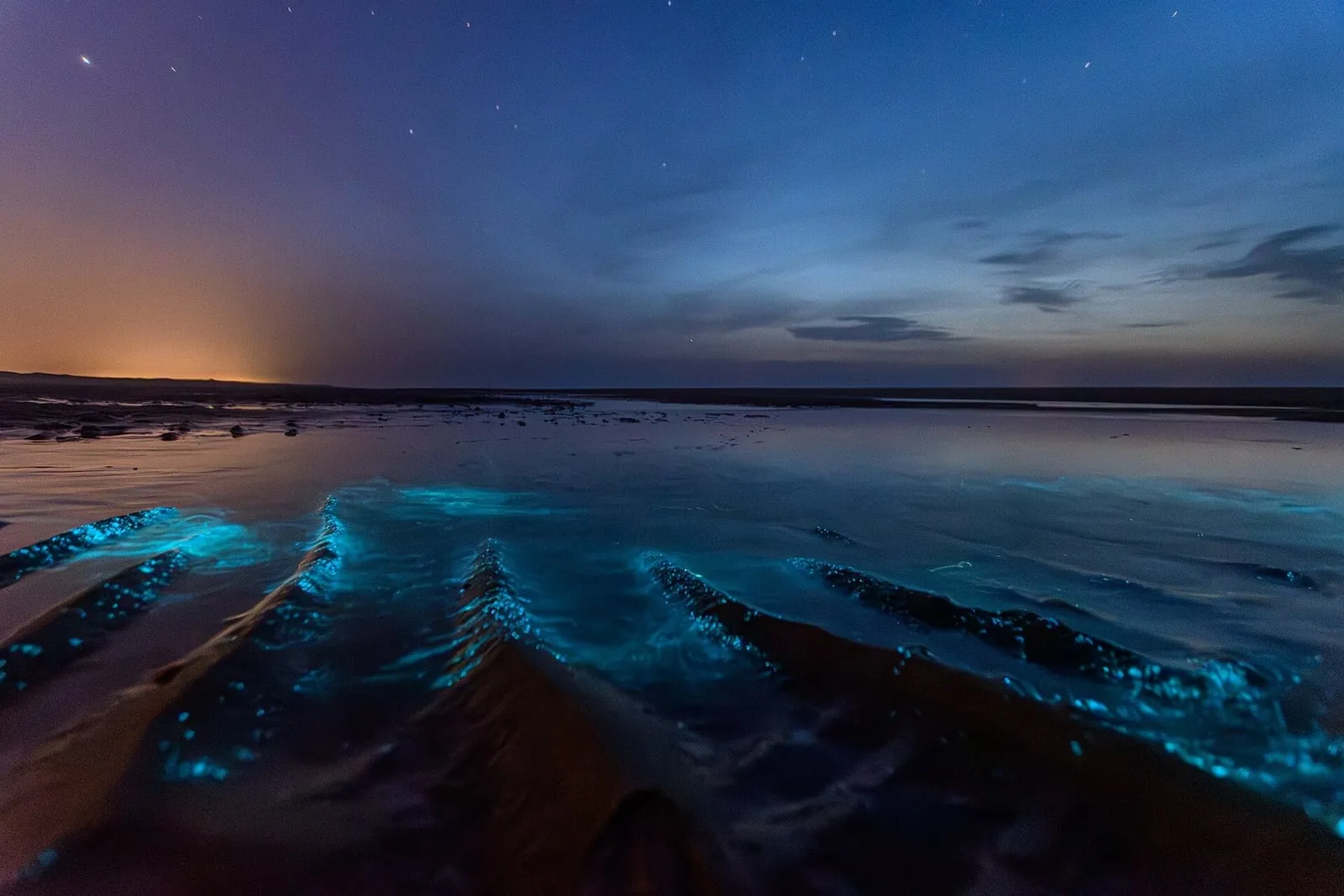
On some nights, the sea along Phu Quoc’s beaches glows. Every breaking wave, every stroke of your hand through the water, lights up with tiny sparks of blue. It is one of the most magical things you can see on the island — swimming under the stars with the water glowing around you.
It is also unpredictable. The glow comes and goes with the plankton in the water, nobody can forecast it, and as of October 2026 we know of no tour on Phu Quoc that takes you to see it. This guide is about improving your odds.
The photo above was taken on Norderney in Germany, not on Phu Quoc; the glow looks the same.
What makes the sea glow
The light comes from dinoflagellates, single-celled plankton that give off a flash of blue light when the water around them is disturbed — by a wave, a boat, a fish or your hand. A common one in the Gulf of Thailand is Noctiluca scintillans, often called “sea sparkle”. When it multiplies into a dense bloom it can turn the water green or reddish-brown by day; satellite studies of the upper Gulf of Thailand link the timing and spread of these blooms to the monsoon winds, rainfall and river discharge.
The glow is not there every night, and it can be bright on one beach and absent on the next. A few things help:
- Darkness. Moonlight and artificial light wash it out. The nights around the new moon are best.
- Movement. The plankton only light up when disturbed, so look where waves are breaking, or stir the water with your hand or foot.
- Calm, warm spells. Blooms often follow a spell of warm, calm weather.
Where it has been seen on Phu Quoc
Over the years the glow has been spotted in these places:
- The southern section of Long Beach (Bai Truong).
- Just north of Dat Dao beach in An Thoi, at the southern tip.
- Off Rach Vem on the north coast, near Ganh Dau.
- The north-east of Bai Thom.
What these have in common is darkness. The busiest stretches — northern Long Beach, Duong Dong, Sunset Town and the Bai Dai resorts — are lit up all night. The north and north-east coasts have far fewer hotels and street lights, which gives you a better chance. On any beach, walk away from the resort lights and the bars.
How to see it
- Pick a dark night, as close to the new moon as you can, and go out at least an hour after sunset.
- Turn off your torch and your phone screen and give your eyes 15–20 minutes to adjust. The glow is faint until your night vision kicks in.
- Watch the waterline. If the plankton are there, you will see flickers of blue as the small waves break.
- Wade in to your knees and move your hands through the water. That is usually enough — you do not need to swim.
There are no plankton-watching tours on the island, but one way to get out on the water after dark is a night squid-fishing trip. The bright lamps the boats use to attract squid make the glow hard to see, but it is worth looking over the dark side of the boat.
Night swimming safety
- Never swim alone at night, and never after drinking. The beaches are unsupervised at night.
- Stay in shallow water close to shore. On the west coast (Long Beach, Ong Lang, Bai Dai), the sea can be rough with strong currents from May to October; see our weather guide.
- Watch for jellyfish. Jellyfish are most common from late November to mid-December, with a smaller season of small jellyfish from late April to early May. A long-sleeved rash guard helps.
- Bring a torch for the walk back — with a red light if you have one, so you do not spoil everyone’s night vision.
- Avoid discoloured water. If the sea looks green, red or brown and smells bad by day, it may be a dense algal bloom; swim elsewhere.
Photographing it
The glow is much fainter than it looks in the famous photos, which are long exposures. To capture it you need a camera or phone on a tripod or steady surface, a long exposure of 10–30 seconds, a high ISO and a wide-open aperture. Phone night modes can pick it up if you hold still. Do not use flash — you will see nothing but the water.
Science: Luang-on et al., Frontiers in Marine Science, 2023. Jellyfish seasons: Vietnam Explorer dive centre. Checked October 2026.