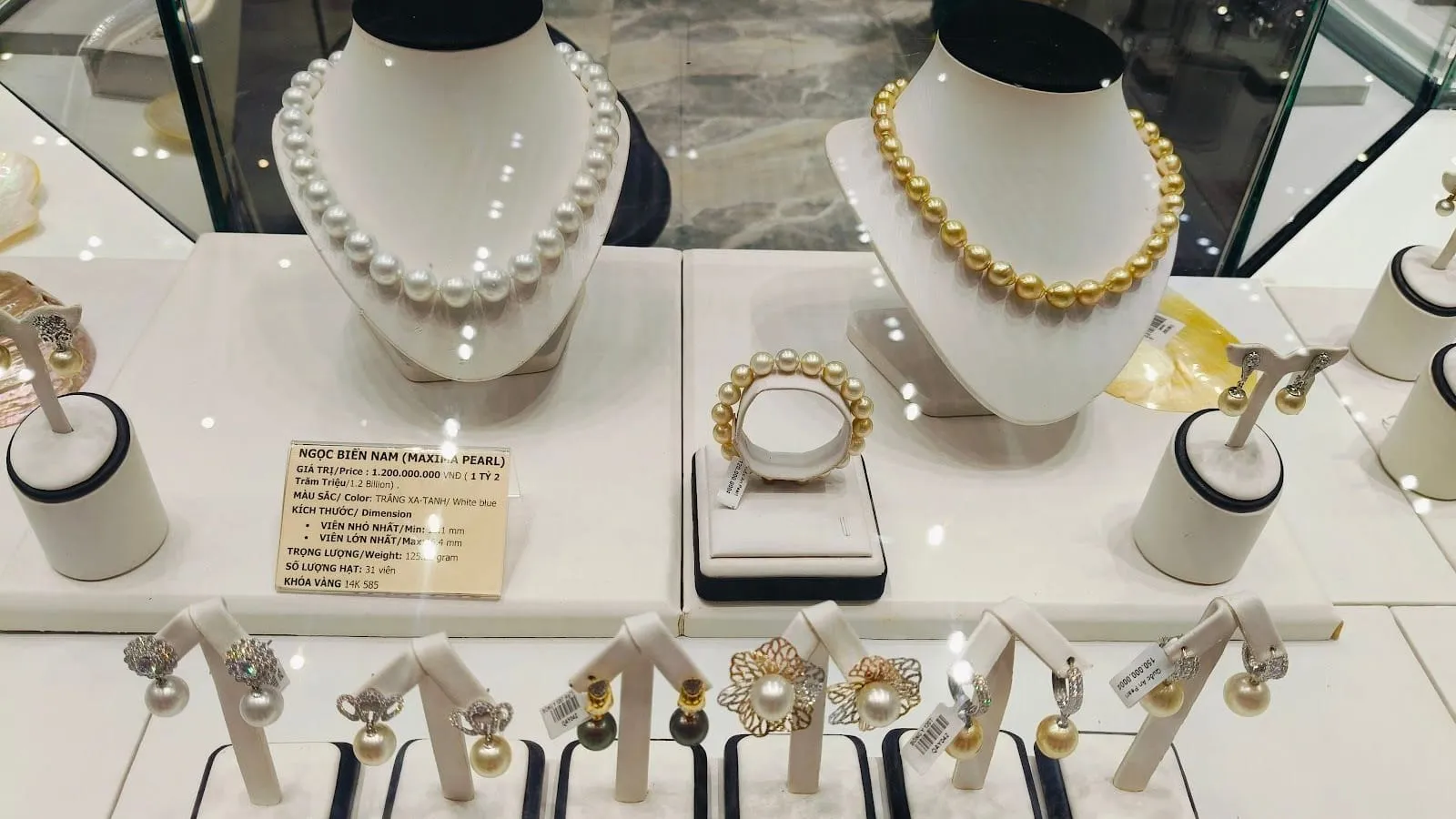
Pearls are Phu Quoc’s best-known souvenir after fish sauce and pepper. The island has farmed cultured saltwater pearls since the 1990s, mostly from the large gold-lip and silver-lip oyster (Pinctada maxima), which produces round golden or silvery pearls of 10 mm and more. Smaller amounts of akoya, black “Tahiti”-type and mabe (half) pearls are also cultured here (Việt Nam News, October 2025). Not every pearl sold on the island comes from these farms, though — so it pays to know what you are buying.
How Phu Quoc pearls are made
The best-documented farm is Ngoc Hien, founded in 1994 by a former diver who learned the trade working for a Japanese-run pearl company on the island (Saigon Times, June 2026). Today it cultures oysters over a large sea area at Rach Vem in the north and exports most of its harvest — around 70% to Japan, according to Việt Nam News.
A small bead (the nucleus) is implanted into each oyster, which coats it in layer after layer of nacre. A large gold or silver pearl takes years to grow — six or seven for the biggest — and a third or more of the oysters die along the way (Việt Nam News), which is why genuine large pearls are expensive. The biggest pearl Ngoc Hien has harvested measured 21 mm and sold for 1.2 billion dong (Việt Nam News, 2025).
The pearl showrooms
Several companies run large showrooms that combine a small museum, a demonstration of how pearls are seeded and harvested, and a big shop. They are free to visit:
- Ngoc Hien Pearl Farm (Tran Hung Dao, Long Beach, near the airport; open about 8:00–19:00) — 4.2 on Google Maps from 3,777 reviews (October 2026). Reviewers in 2026 found the demonstration and the displays of shells, coral and shipwreck finds interesting, with English-speaking guides; it also has a shop at the airport.
- Quoc An Pearl (Suoi May, inland from the airport) — 4.1 from 1,128, with a similar presentation and a large collection of shipwreck relics and carved giant-clam shells.
Most reviewers enjoyed the visit. The common complaint is the sales pressure that follows it: several felt shadowed by staff throughout the shop. Some taxi and Grab drivers bring passengers to a pearl showroom on the way to somewhere else; you are under no obligation to go, or to buy.
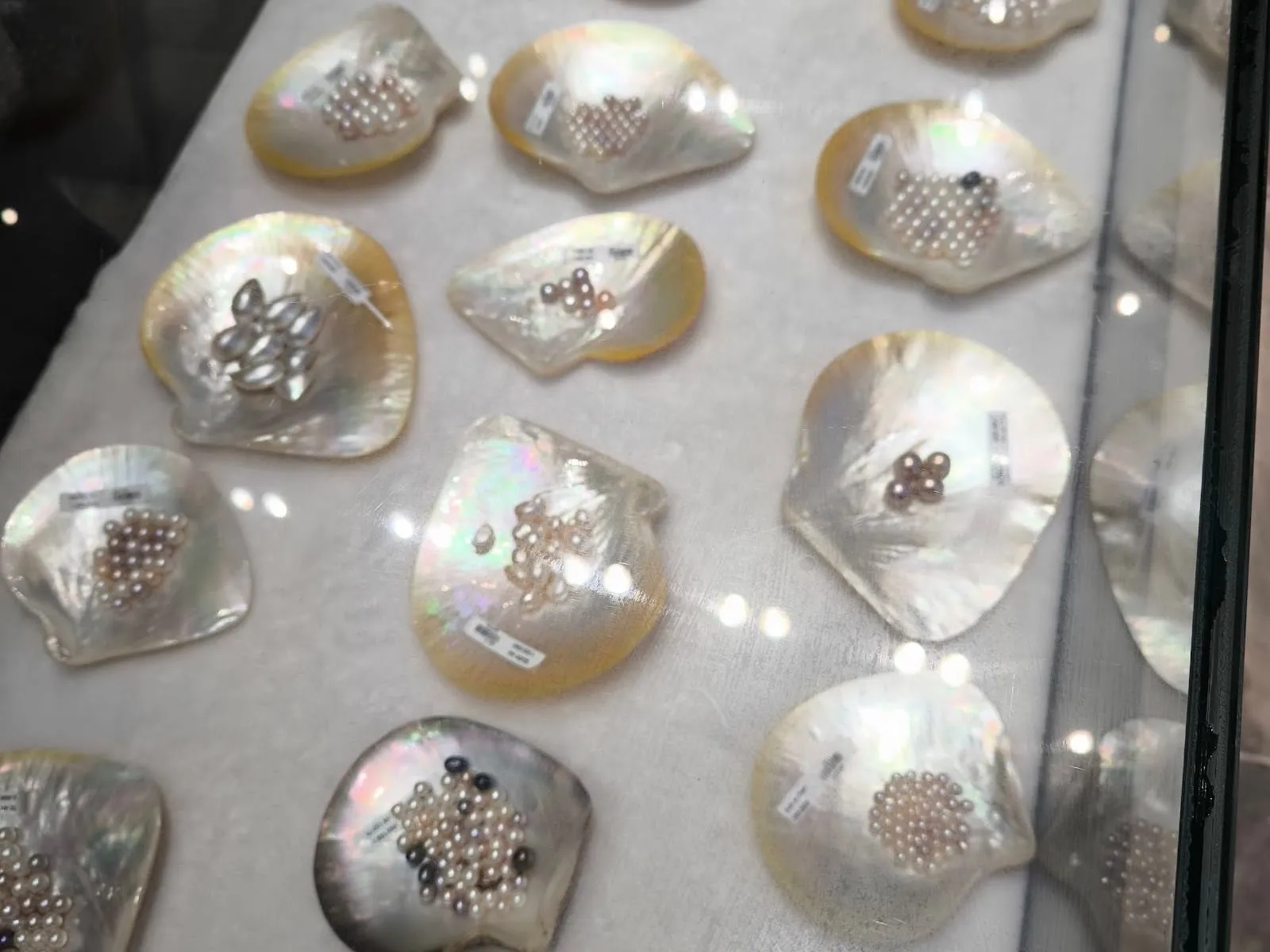 Pearls in their shells. Photo: Sarka Hanak Palovska, via Google Maps
Telling real pearls from fakes
Fakes and cheap imported pearls are sold at tourist spots in Vietnam, Phu Quoc included — from coated glass and plastic beads to freshwater or low-grade pearls passed off as local saltwater ones. Advice from Prof. Phan Truong Thi, head of the Vietnam Institute for Research on Gold, Gemstones and Jewellery (Sức khỏe & Đời sống, 2022):
- Price is the first clue. A strand offered for one or two million dong is very likely fake; genuine cultured saltwater strands start at around five million dong and go up to hundreds of millions.
- Touch and teeth. Real pearls feel cool to the touch, and slightly gritty when rubbed gently against your front teeth; imitations usually feel smooth. It is a first check, not proof.
- Weight tells you nothing — some plastic fakes weigh as much as pearls.
- Look closely. One or two tiny blemishes are normal on a real pearl; perfectly identical, flawless beads on a cheap strand are a warning sign.
- Only a laboratory can be certain. X-ray testing at a gem lab distinguishes natural, cultured and imitation pearls.
Do not “test” a pearl by burning it or scratching it with a knife, as some websites suggest: it can damage a genuine one.
Before you pay
- Get it in writing. Ask for an invoice that states whether the pearls are saltwater or freshwater, the type and the size. If a certificate is promised, check exactly what it is before paying — one buyer in 2026 was promised a certificate of authenticity and given only a sales receipt.
- Compare prices between two or three shops, and do not feel rushed.
- For expensive pieces, consider having them checked by an independent gem laboratory at home; a lab report is the only real guarantee.
- Very cheap strands at market stalls are, by the experts’ rule of thumb above, almost certainly not Phu Quoc saltwater pearls — fine as costume jewellery, if that is what you pay for.
For other things to take home, see souvenirs from Phu Quoc.
Ratings and visitor comments: Google Maps, 2025–2026. Pearl facts: see sources.