Cao Dai (Đạo Cao Đài) is a Vietnamese religion, and Phu Quoc has a special place in its story. The temple in Duong Dong is small compared with the great Holy See at Tay Ninh near Ho Chi Minh City, but it is colourful, free to visit and a few minutes’ walk from the night market and Dinh Cau.
What is Cao Dai?
Caodaism — in full Đại Đạo Tam Kỳ Phổ Độ, the “Great Way of the Third Period of Salvation” — was formally founded at Tay Ninh in 1926. It worships one God, called Cao Dai, together with the Holy Mother, and teaches that the world’s great religions come from the same source; it blends Buddhism, Taoism and Confucianism with elements of Christianity, and its church is organised in a hierarchy modelled on the Catholic one. Its best-known symbol is the Divine Eye, a left eye inside a triangle or globe, which you will see above the altar. Among the figures it honours as saints are Victor Hugo, Sun Yat-sen and the Vietnamese poet Nguyễn Bỉnh Khiêm. It has millions of followers, mostly in southern Vietnam.
Why Phu Quoc matters
The religion’s first disciple, Ngô Văn Chiêu, was a colonial official who was posted to Phu Quoc in October 1920. On the island he held spiritual séances at a small Quan Âm shrine on a hill in Duong Dong, and he formally began his practice there at the Lunar New Year of 1921. Caodaists therefore regard Phu Quoc as the place where the faith’s revelation began, several years before its official founding on the mainland.
The temple
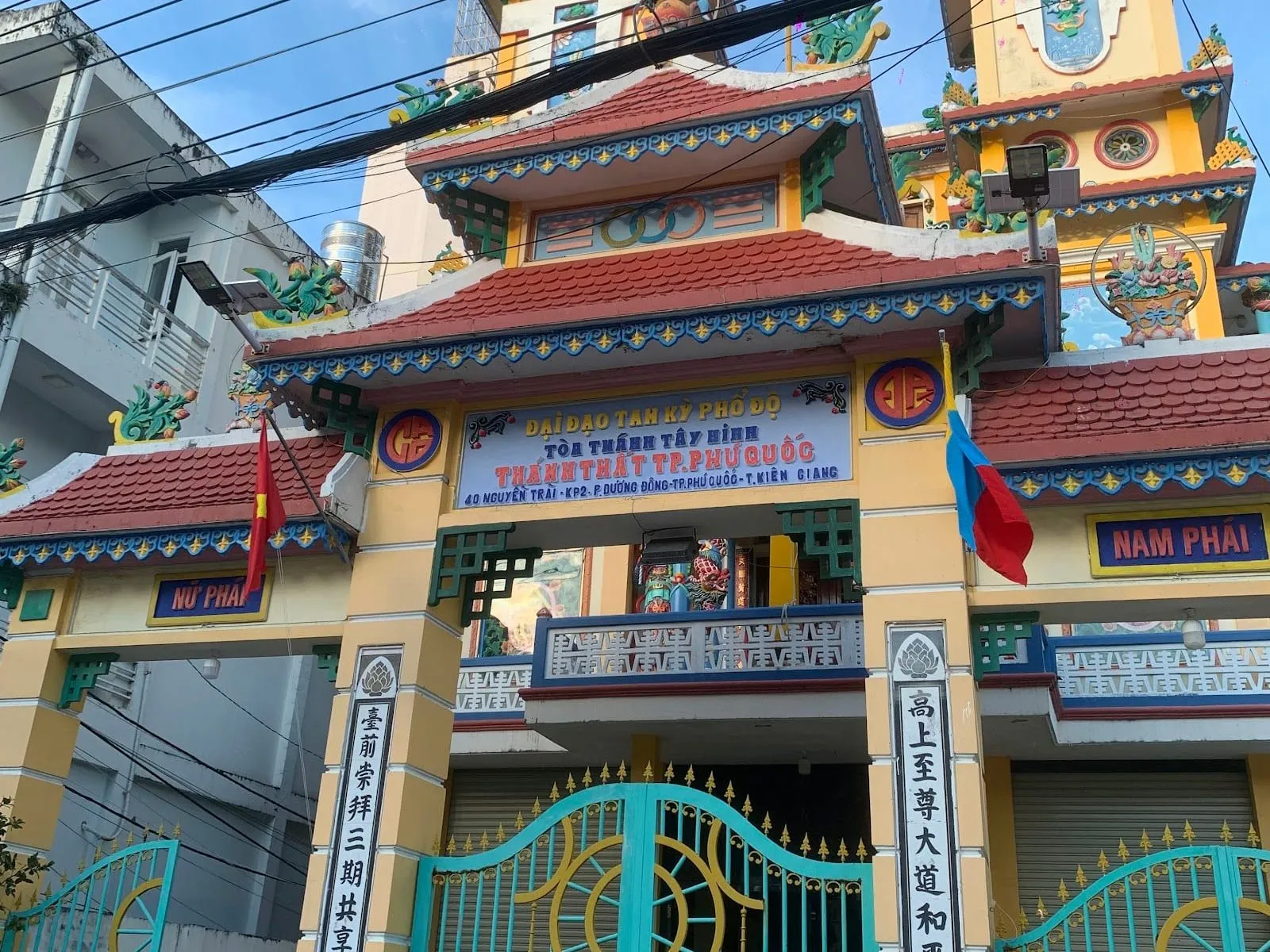
The best-known Cao Dai temple on the island stands on Nguyen Trai street in Duong Dong, near the night market. Its twin towers and facade are painted in bright colours, with dragons, lotus flowers and the Divine Eye; inside, the altar is set under the Eye, and from the upper floor there are views over the town and the river. On Google Maps it scores 4.2 from 42 reviews: visitors like the colours and the friendly welcome, while some found it quiet and fairly bare inside compared with Tay Ninh.
There is a second, less visited Cao Dai temple on 30 Thang 4 street at the edge of town. Different Cao Dai branches use different temples, and we could not confirm which branch worships at which.
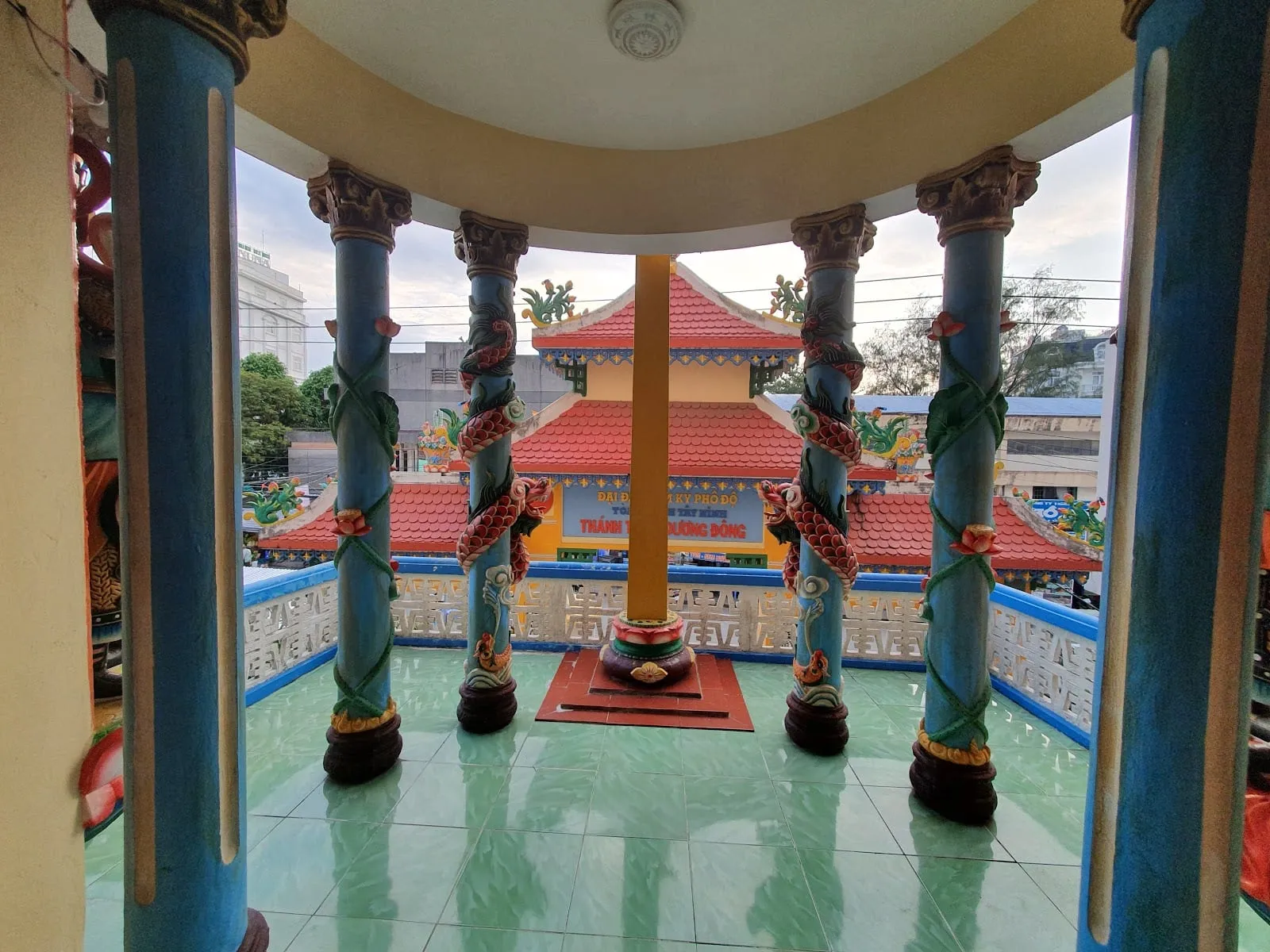 Photo: Trung Ruan, via Google Maps
Visiting
- Entry is free. Dress modestly — shoulders and knees covered — and take off your shoes where you are asked to.
- Ceremonies: Cao Dai followers traditionally pray four times a day, at 6:00, 12:00, 18:00 and midnight; visitors can usually watch quietly from the side. Ask before photographing worshippers.
- The stairs to the upper floors are narrow and steep.
- Combine it with Dinh Cau, the night market and the town’s other temples and pagodas.
Ratings and visitor comments: Google Maps, October 2026. History: see sources.
Map
Loads Google Maps when you tap. Or open in Google Maps.